Creating a seamless event experience often comes down to the details that guests don’t discuss, but always notice. In fact, industry event planning guidelines consistently show that insufficient restroom capacity is one of the top reasons for guest dissatisfaction at outdoor events, especially when attendance crosses 100 guests.
For small weddings and VIP events, this raises an important question: Is a 2-stall restroom trailer enough? With restroom providers, this is one of the most common planning considerations. Understanding how capacity works in real scenarios helps ensure your event remains smooth, comfortable, and well-managed from start to finish.
At Restroom Resources, a New Jersey-based restroom trailer provider, the focus is not just on providing restroom trailers, but on helping event planners match capacity with real usage patterns. Because when restroom planning is done right, guests stay comfortable, and the event runs exactly as intended.
How Many People Can a 2 Stall Restroom Trailer Handle Per Hour?
A 2-stall restroom trailer can realistically serve around 25 to 40 people per hour, but this number depends heavily on how your event flows. Guests don’t use restrooms at a constant rate; they tend to move in waves, especially during key moments like after meals or before major activities. A 2-stall restroom trailer typically supports:
- Higher usage during peak periods
- Lower usage during quieter phases
A 2-stall restroom trailer is designed for steady flow, not simultaneous peak demand, which is why timing matters more than total guest count.
What Is the Standard Restroom-to-Guest Ratio for Events?
The commonly accepted guideline is one restroom stall for every 50 to 75 guests during a 4 to 6-hour event. While this works as a starting point, it doesn’t always reflect real-world conditions. But a 2-stall restroom trailer is typically sufficient for a 100-guest wedding. At this size, usage tends to remain manageable, especially if the event is structured in phases and guests are not all using facilities at the same time.
Factors like alcohol service, event duration, and guest movement can quickly change how often facilities are used. So while the ratio gives you a baseline, it’s the adjustments that determine whether your setup works smoothly. Alcohol consumption can increase restroom usage frequency by up to 20–30%, particularly during key moments like post-dinner transitions.
How to Calculate Restroom Capacity Based on Real Event Conditions
The most reliable way to calculate restroom needs is to combine standard ratios with real-world adjustments. Start with your guest count and apply the basic guideline, then refine it based on how your event is expected to flow.
For example, a 120-guest wedding with alcohol may require more consideration than a 120-guest corporate event without it. Duration, timing, and guest behavior all influence how much capacity you actually need.
Teams like Restroom Resources, which regularly support events across New Jersey, often look beyond basic ratios and consider factors like peak usage windows, guest movement, and event structure to arrive at a more practical setup.
This kind of input helps ensure the final plan reflects how the event will actually feel for guests, not just how it looks on paper.
How Gender Ratio Affects Restroom Capacity
Restroom usage is not always evenly balanced, and events with a higher percentage of female guests may require additional capacity. This is because average usage time can be slightly longer, which becomes noticeable during peak periods. Even a small imbalance can lead to longer lines if it’s not accounted for during planning.
Events with a higher female guest ratio often require additional restroom capacity to maintain smooth flow during peak usage. This means capacity should reflect who is attending, not just how many people are attending.
What Size Restroom Trailer Should You Choose for Weddings vs Corporate Events?
The right trailer size depends not just on guest count, but on how people interact during the event. Weddings tend to have more clustered usage, while corporate events usually follow a more staggered pattern. This difference directly affects how a 2-stall restroom trailer performs in real conditions.
| Factor | Weddings | Corporate Events |
| Guest movement | Group-based, clustered | Staggered, scheduled |
| Peak usage timing | High spikes (after dinner, before dancing) | Distributed across breaks |
| Wait time risk | Higher during peak moments | Lower due to even flow |
| Capacity pressure | Feels tighter even at lower guest counts | Handles higher counts more comfortably |
| Planning sensitivity | Requires a buffer for peak demand | More predictable and manageable |
In simple terms, a setup that works comfortably for a corporate event may require additional planning for a wedding with the same number of guests.
What Happens If Restroom Capacity Is Too Low?
Most restroom-related complaints are caused by peak demand miscalculations, not total guest count. When restroom capacity is underestimated, the impact is immediate. Lines begin to form, guests start waiting longer than expected, and the overall rhythm of the event is disrupted.
Even if everything else is well planned, this single issue can change how the event feels. It shifts attention away from the experience and toward inconvenience.
Signs Your Restroom Setup Isn’t Enough
Capacity issues often reveal themselves early in the event. You may start noticing small disruptions that indicate demand is exceeding what the setup can comfortably handle.
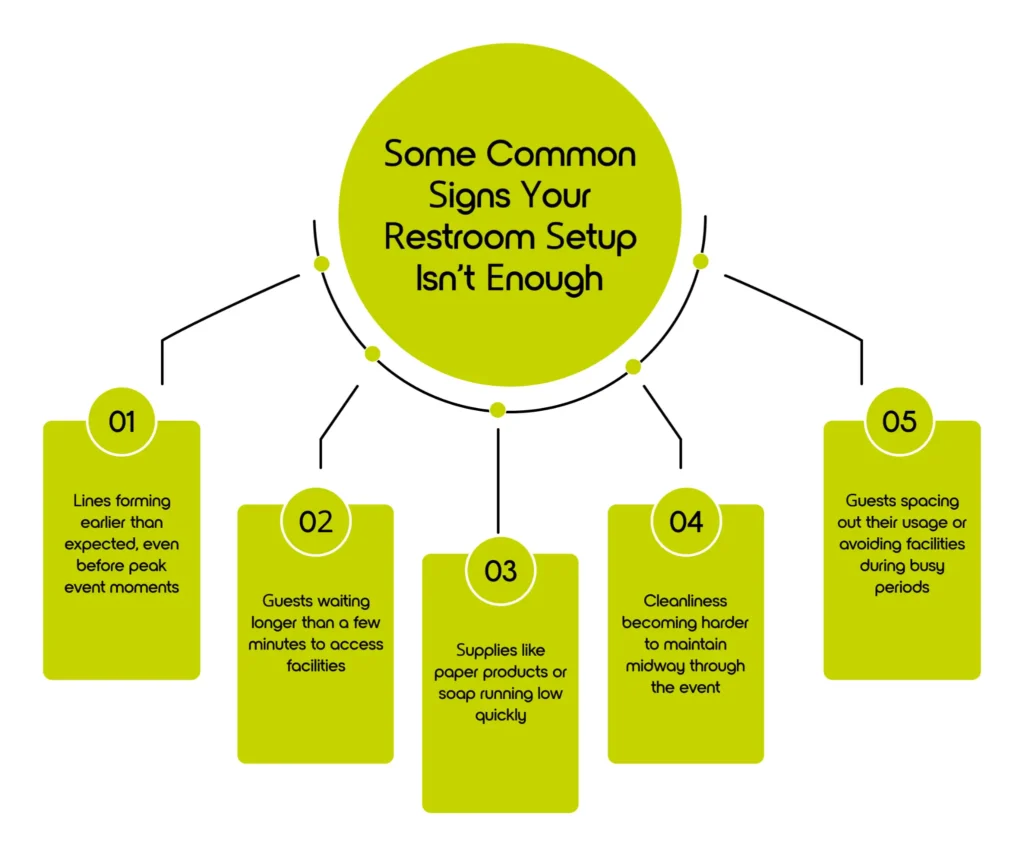
These signs usually point to one thing: peak demand wasn’t fully accounted for, even if the overall guest count seemed manageable.
What Size Restroom Trailer Should You Choose?
| Event Type | Recommended Setup |
| Small wedding (50–100 guests) | 2-stall trailer |
| Medium wedding (100–150 guests) | 2 stalls with planning |
| Corporate events | 2–3 stall trailers |
| Larger gatherings | 3–4+ stall trailers |
How to Maintain a Luxury Restroom Experience
Maintaining a luxury experience comes down to consistency. Even with high usage, the environment should remain clean, accessible, and comfortable throughout the event.
This depends on planning ahead, ensuring supplies are stocked, usage patterns are anticipated, and the trailer is positioned in a way that supports easy access without crowding.
At real events, usage patterns are predictable. For example, restroom demand often increases after meals or during transitions. Planning around these moments helps maintain the overall experience.
Event Planning Across New Jersey
Across New Jersey, many events take place in outdoor or temporary venues where permanent facilities aren’t available. From private estates to open-air venues, restroom trailers become a key part of the guest experience.
Seasonal factors also play a role. Summer heat can increase usage, while fall events often create tighter timelines with more concentrated activity.
Restroom Resources works with event planners across New Jersey to align restroom capacity with real event conditions, ensuring setups are both practical and comfortable.
Key Takeaway
A 2-stall restroom trailer is a strong choice for 100 to 150 guests, but success depends on how well you account for real-world factors like alcohol, timing, and guest behavior, not just numbers. If you want a deeper understanding of setup, pricing, and logistics, refer to the complete guide on 2-stall restroom trailers to plan your event with more confidence.
Frequently Asked Questions
1. How do I know if my restroom trailer capacity is enough before the event starts?
You can estimate this by looking at guest count, event duration, and peak activity timing. If your schedule includes moments where many guests move at once, like after dinner or during breaks, it’s a sign you may need additional capacity or a buffer.
2. What factors affect restroom trailer capacity the most at outdoor events?
The biggest factors are alcohol service, event duration, weather conditions, and guest movement patterns. These influence how often and when guests use the facilities, which directly impacts capacity.
3. Do outdoor venues in New Jersey require different restroom planning?
Yes. Many outdoor venues across New Jersey do not have permanent facilities, so restroom trailers must handle full demand. Weather conditions and terrain can also affect usage and placement.
4. How can I reduce restroom lines during peak event hours?
You can reduce lines by placing trailers strategically, planning for peak usage windows, and ensuring capacity matches guest behavior, not just total attendance.
5. How can I reduce restroom lines during peak event hours?
You can reduce lines by placing trailers strategically, planning for peak usage windows, and ensuring capacity matches guest behavior, not just total attendance.